Preparation, Journey and Day 1: Sankri to Seema Village (You are currently reading this.)
Day 2: Seema Village to Har-Ki-Dun
Day 3: A day in Har-Ki-Dun
Day 4: Har-ki-Dun to Seema Village and Visit to Osla
Day 5: Seema Village to Sankri and Return Journey
Lots of young faces, anxious parents gathered to see their young wards off! Emotions galore! A scene on Pune Railway Station on 6th May, 2015! I found myself in the company of five to six 10th Std boys and suddenly sound of “Kaka” (uncle) reverberated through my ears making me realize that I would be reminded of my age throughout the trek. On the happy side, these cherubic kids instantly upped the energy level of the whole compartment and our train "Sampark Kranti Express" soon departed towards Delhi, our first transit before proceeding to Dehradun. Finally a journey to my first Himalayan Trek had just begun.
Day 2: Seema Village to Har-Ki-Dun
Day 3: A day in Har-Ki-Dun
Day 4: Har-ki-Dun to Seema Village and Visit to Osla
Day 5: Seema Village to Sankri and Return Journey
Lots of young faces, anxious parents gathered to see their young wards off! Emotions galore! A scene on Pune Railway Station on 6th May, 2015! I found myself in the company of five to six 10th Std boys and suddenly sound of “Kaka” (uncle) reverberated through my ears making me realize that I would be reminded of my age throughout the trek. On the happy side, these cherubic kids instantly upped the energy level of the whole compartment and our train "Sampark Kranti Express" soon departed towards Delhi, our first transit before proceeding to Dehradun. Finally a journey to my first Himalayan Trek had just begun.
A choice to trek to Har-Ki-Dun was made after consultation
with my trek mates “Sandeepak Phadke” and “Ajay Deshpande” who are regular Himalayan Trekkers. Actually I had planned the same trek in 2014 but had to cancel it after breaking my wrist bone. I had to
really wait for a whole year to finally make it happen. As this was going to be
my first Himalayan Trek, I left no stone unturned and prepared thoroughly right from achieving the extreme fitness to choosing the right gears for the trek..
My enthusiasm for the hike was marred by the disastrous earthquakes in Himalayan range of Nepal. It also had an impact on North India. Lives lost especially at the site of Everest Base Camp made Himalayan Trek too dangerous at the time. But looking at the Garhwal Himalaya region which was least affected by the earthquake, I decided not to cancel the trek plan and proceeded with it. No doubt, there were few protests from the family till the last day of my departure, but I trusted Yuvashakti Organization's network in Himalaya who assured that trek to Har-Ki-Dun would be safer.
My enthusiasm for the hike was marred by the disastrous earthquakes in Himalayan range of Nepal. It also had an impact on North India. Lives lost especially at the site of Everest Base Camp made Himalayan Trek too dangerous at the time. But looking at the Garhwal Himalaya region which was least affected by the earthquake, I decided not to cancel the trek plan and proceeded with it. No doubt, there were few protests from the family till the last day of my departure, but I trusted Yuvashakti Organization's network in Himalaya who assured that trek to Har-Ki-Dun would be safer.
After painstakingly slow journey from Pune to Delhi (28 hrs total) and further from Delhi to Dehradun (6 hrs), we reached to Dehradun. A long journey enabled me to finish a book "Kaali Aai" - a collection of short stories by a well-known Marathi Author - Vyankatesh Madgulkar. When I was not reading, I chatted with other group members - Tejas Joshi (our Trek Leader), Naydu Uncle (64 Yrs and eldest member of the group) and other members of our group.
It was close to 10 pm when we arrived at Dehradun. As it was late, we were directly taken to a restaurant in Dehradun where we feasted on good North Indian food.Later we walked for about 500 mts to a comfortable hotel “Drona” of GMVN (Garhwal Mandal Vikas Nigam).
We had a good night sleep and in the morning, we started our journey to our base camp, Sankri. Journey was through the ghat routes with quintessential Himalayan roads – narrow, winding and with a lot of blind turns. Driver was young and enthusiastic though his enthusiasm rubbed him to drive the bus with a speed that sent a chill in the spine of everyone. After certain distance, a saga of puking began and happy faces soon turned into sad and dull ones.After arduous journey of about 8 hours, we finally entered the forest region of Govind Vallabh Pant Wildlife Sanctuary where we needed to register the group. After about an hour, we finally reached to Sankri, our base camp. A sight of towering mountains and falling evening dissipated all our lassitude.
With a small introduction to our new trek leaders, we were
provided empty rooms with sleeping mats and
sleeping bags stacked in the corner. After a round of introduction, a hot dinner of Paneer, Chapati, Dal and
Rice was served in a short while. After dinner, we were asked to wash our own
dishes and we soon got the feel of the cold Himalayan water. Soon we settled in our rooms, tucked into the warm sleeping bags and went to sleep.
It had just dawned when I got up in the morning. Weather was pleasant and and despite knowing that a long hike was awaiting me during the day, I couldn't resist the temptation of morning stroll to explore nearby area and have some photography. Our campsite was looking resplendent in the morning's rays.


Though it was very early in the morning, people had begun their work. A woman about sixty was carrying the basket and I requested for her photo and she readily obliged.

As I was returning from my morning stroll, seeing the DSLR in my hand, many group members requested me to take their photos and I happily obliged.
Saurabh Kshirsagar with Himalayan Dog:

Swarali, Sharda and Vishupriya (R to L):

After breakfast of Poha and Sweet Daliya and Tea, we packed our backpacks for the next 5 days, kept the excess luggage at the base camp itself and started our journey in the Bolero Camping Jeep to the place named “Taluka” which was the starting point for the trek. 11 km journey to Taluka was one of the most scenic ones. Along the way, our jeep, Bolero Camper had to negotiate 3 water streams which were crossing the narrow road with full gusto. Road is such in a bad condition that only utterly robust “Bolero Camper” could negotiate it. In the past, even the so-called road from Sankri to Taluka was non-existent and people had to walk for distance of about 11 kms.
Bolero - the sturdy vehicle for rough terrain:

Bolero - the sturdy vehicle for rough terrain:

After a nervous ride and another puking incident by the fellow group member, we reached to Taluka which was the starting point for the trek. Our next camp was at Osla and a marathon walk and hike of 13kms was beckoning us. Most of the group members preferred to offload their heavy backpacks to porters (mules) to hike with the lighter load. I preferred to carry my own backpack as I wanted to test whether I could hike for long distance with the heavy backpack. As I was carrying the heavy camera, I knew I might have to hike with really heavy load. Frankly, I hadn’t hiked in Sahyadri mountains with so much of a load; so this was going to be my first time and I was little nervous about it.
So finally, we were on our way. Real excitement was palpable on everyone’s face as we started our hike into the unfamiliar territory of mighty Himalaya. It was not exactly very pleasant weather as it was slightly on the hotter side. But as compared to the region from where we had come from, it certainly was much colder and more conducive for hiking.
Start of trek from Taluka Village:

After walking for certain distance, we were into the wild;
away from any habitat. Music of gushing water of Supin river originating from the
glacier was accompanying us constantly as trail was just adjacent to the river.
A beautiful Supin river:

A beautiful Supin river:

Great thing about the trail was availability of the fresh,
glacier water at frequent distance. This made us not to stack any water thus
lightening our backpacks as generally water bottles are the heaviest in the
backpack. So we really indulged in the fresh water which kept us well hydrated
throughout the trek.

Bridge on the Supin River:

Omkar on the background of one more bridge:

Another tiny bridge:

Our first real break was at lunch point at a near snacks
joint. But unfortunately, some of us followed a wrong route going to the higher elevation from the lunch point where we had to assemble. Along the wrong trail, I also lost other members as I was stopping frequently for doing photography. Shouts from below made me realize that I was walking alone on the wrong trail. Relieved, I immediately descended and rejoined the group. Other members whom I followed on the wrong route before losing them were also resting in the hut.
We had a packed lunch of Potato Vegetable, Chapati, Gul-Poli, Frooti and Chocolate bar
and after resting for few minutes, we proceeded further.
Lunch Point:

Some fun around Lunch Point:
Nihar, Malhar, Saurabh and Niranjan (four close friends who had just finished their 10th exams):

Local flashing his million dollar smile:

Anurag negotiating the stream by walking on the log:

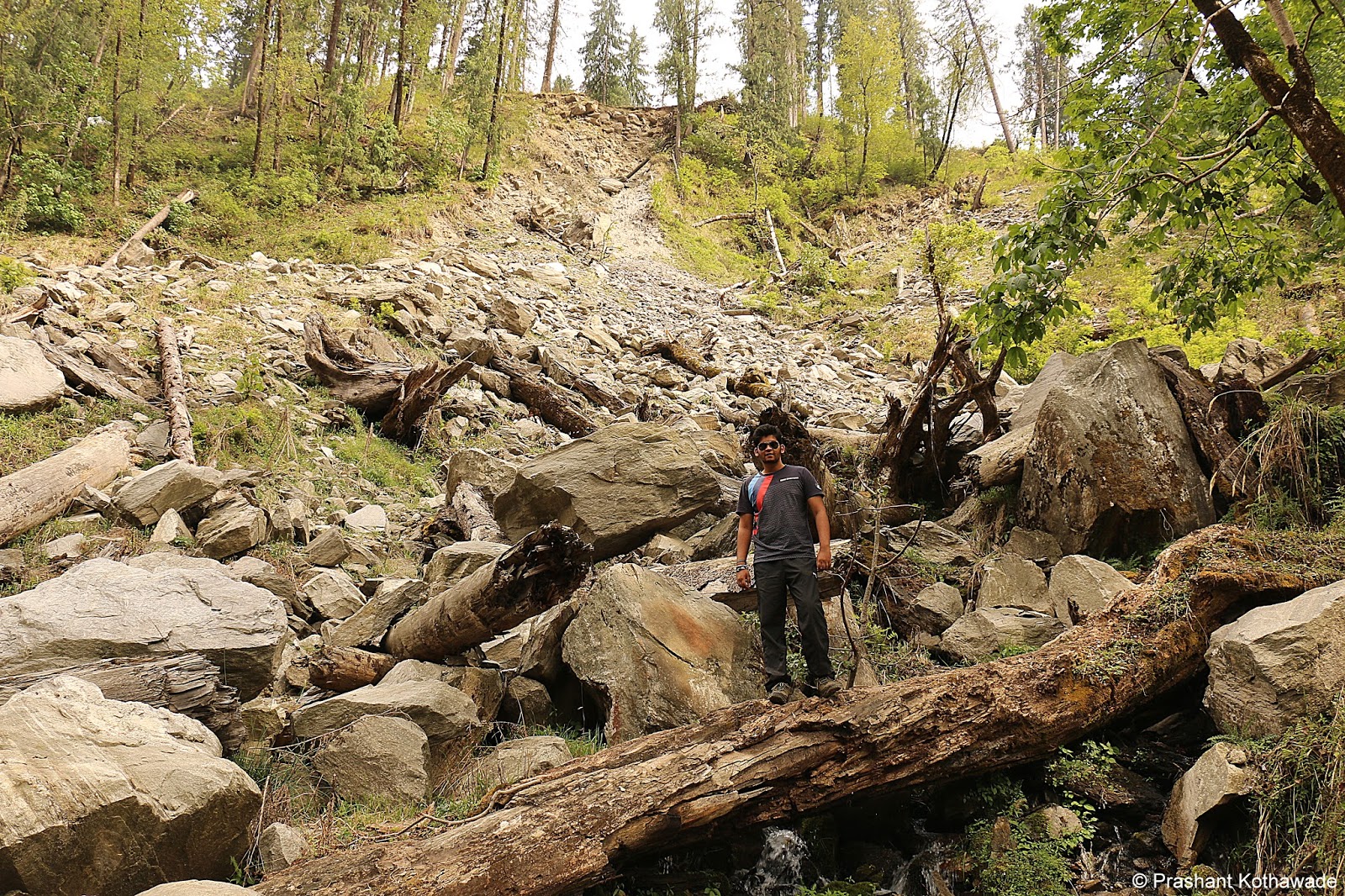
On the way, we were asked to stop as there was some landslide happening in front. Apparently a local shepherd had taken flock of sheep at the higher elevation and their movement was causing boulders to roll down below on the trekking trail. Our local trek leaders were too furious with the shepherd who they told was deaf and lacked the common sense. As we were waiting, our local leader told us the unfortunate tale of a Mumbai Trekker who had lost the life after being hit on the head by a large boulder rolling from the mountain. After waiting for about 15 minutes, we resumed our hike after confirming that sheep had moved out of sight.
We had walked a lot from Taluka without any habitat in sight. So we felt good when we sighted a beautiful village named "Gangar" in the lap of a beautiful nature. Our trail was not going through the village as there was river in between our trail and the village. Ahead, we saw a bridge connecting the trail to the village but as we had to hike further, we did not visit the village.
Lunch Point:

Some fun around Lunch Point:
Nihar, Malhar, Saurabh and Niranjan (four close friends who had just finished their 10th exams):

Local flashing his million dollar smile:

Anurag negotiating the stream by walking on the log:
We had walked a lot from Taluka without any habitat in sight. So we felt good when we sighted a beautiful village named "Gangar" in the lap of a beautiful nature. Our trail was not going through the village as there was river in between our trail and the village. Ahead, we saw a bridge connecting the trail to the village but as we had to hike further, we did not visit the village.
Gangar Village:

There are few snacks joint on the trail just before the Gangar Village.
Local kids in the snacks joint:

In the afternoon, suddenly weather changed and dark clouds hovered in the sky and it started raining. It was kind of hailstorm and soon hailstones started lashing us hardly. We ran for a shelter and gathered below the shade of a house. Once the rain was subsided, we resumed our walk.


As we were gaining elevation, snow peaks visible from the trail created a surge of excitement.


Along the way, we came across tents of other trek group but our campsite was nowhere in sight. Vijay, local trek leader kept everyone motivated by saying that camp was just around the corner even though it was still many kilometers ahead. As few of the members were suffering from utter exhaustion, they were taking frequent breaks and it was becoming really late. Because of absence of any mobile range, it was difficult to guess where the last remaining group was. Gradually I picked up the speed at the last stretches and walked along with Vijay at a very fast pace. Vijay complimented me about my speed; on the other side he was quite flustered about the slow moving group as we were running quite behind a schedule.
Finally Vijay halted as it was becoming darker and members
behind were not in sight. As Vijay was waiting, I took his permission to go further on the trail and arrived at Seema village. I was not sure about the campsite; so I perched on the rock waiting
for others to come and enjoying the evening hues on the horizon.


I waited for more than 30 minutes but there was no sign of anyone joining me. A bit worried, I again went back for about 200 meters to see what had happened and finally heaved a sigh of relief to see hoard of members coming my way.
Without waiting for all members to join, we were ushered into our campsite and after getting settled, we sat in the area in front of the house. I sat on the wall and waved to group members to show them the campsite.
Without waiting for all members to join, we were ushered into our campsite and after getting settled, we sat in the area in front of the house. I sat on the wall and waved to group members to show them the campsite.
Just before the dark, all members made it to the campsite;
some so exhausted with the exertion that they already made their minds that
they could not take it anymore and they would probably skip rest of the trek. As
soon as everyone arrived, a hot tea was served and all members ushered in in
their respective allocated rooms. I was sharing the room with Naydu Uncle and
Ameya Dandekar.
Soon it was utterly dark outside. As this village was
without the electricity, tent lights placed in each room was the only source of
light. Soon, our trek leader blew the whistle to indicate dinner was ready and all members gathered at the ground floor hall. Though dinner was not sumptuous by
any means, care was taken to make it healthy. Members finicky about particular
choice of food found it difficult to eat their full quota really needed to
replenish the calories burnt and to get ready for next day’s another strenuous
hike.
After a little chat, I went in the room. As bed was only for
2, I slept on the floor in the sleeping bag. Cold had started to creep in the room but warmth
of sleeping bag provided so much of comfort. A wave of exhaustion took over and
I experienced really a dreamless and sound sleep oblivious to the bad state of
few of group members who were going through continuous spate of loose motions
throughout the night. I realized it only when it dawned the next morning and I
started to gear up for another exciting hike.
After breakfast, a total count of members discontinuing the
trek went up to 6. Our local trek leader made arrangement of these members to
stay in a very small house in front of the house where we had stayed for the
night. Members staying behind wished us good luck for rest of the hike. There was a tinge of
disappointment in their voices but also relief that they would get much needed rest
to cure their illness and gain back the strength. We also wished them speedy
recovery and marched towards our next destination, Har-Ki-Dun.
Click here to read Part 2
Click here to read Part 2